
Eurocrash: the dominoes start to fall
Wednesday 3 April 2013
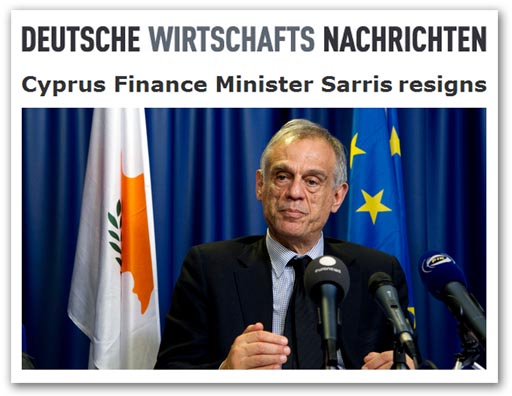 Sarris gives as his reasons the harshness of the bailout deal, but also the fact that he is under suspicion for warning insiders about the impending compulsory levy, thus enabling them to get their money out of the country. But, as an investigation commission is sworn in, president Anastasiades is also under considerable pressure to go, as he too has been implicated in taking advantage of insider knowledge. For Die Welt, however, the commission is largely irrelevant as it will find nothing we didn't already know, yet will skirt round the most important facet of the crisis – the Cyprus was extremely badly governed. The main flaw, however, is rarely emphasised – the hubris of the "colleagues" in thinking that countries such as Greece and Cyprus could easily be absorbed into the eurozone, without penalty. But, given the hand they had to play, there were very few options available, especially when confronted with the particular structure of the Cypriot banking system. There is thus a growing sense of irritation in Germany, mixed with concern verging on alarm, at the way it is being scapegoated, to the extent that, if the "German bashing" continues, there is a real fear that the project will be damaged. That doesn't stop the likes of Heffer sounding off about the "Fourth Reich", or Kavanagh in The Sunrailing against the "arrogant EU" sparking panic by "confiscating cash from ordinary savers". On a point of information, it was actually the Cypriots who proposed the levy for the sub-€100,000 depositors, but at least Kavanagh is right in averring that the likes of Greece and Cyprus should never have been admitted to the eurozone. But while this is at the heart of the current crisis, we need to remind ourselves that it is in no-one's best interest to see a disorderly collapse of the euro. The consequences would be dire, and the UK would not escape damage. And nor indeed is it in anyone's interest for corruption and mismanagement to be so prevalent in the "clubMed" countries. For this, as Sarris is now finding, there always had to be a reckoning, and it was never going to be painless. If there are to be lessons learned from all this, then, it is that the people always end up suffering from the sins of their masters. If we are to prevent this, we much take a greater part in controlling our own destinies, and the conduct of our governments. COMMENT: CYPRUS COMBINED THREAD Richard North 03/04/2013 |
Food fraud: fish - a predictable finding
Tuesday 2 April 2013
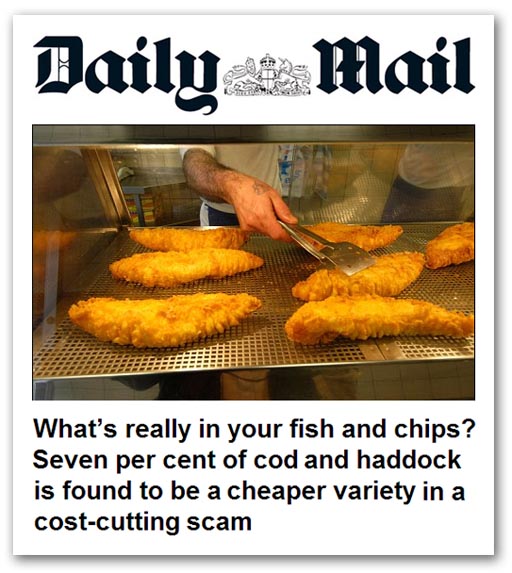 And so it has proved to be, with "huge amounts of cheap fish are being passed off in Britain as more expensive varieties as consumers fall victim to a 'murky and complex' cost-cutting scam". Research carried out by the University of Salford has found that seven percent of cod and haddock - the staple of British fish and chips - are being mislabelled in supermarkets, shops and restaurants in what the Mail calls "a worrying parallel to the horsemeat scandal". This is, by comparison with the US, where 33 percent of samples were mislabeled, is a relatively modest amount. My guess is that if processed fish products, such as fish fingers and fish cakes, were looked at, the substitution rate would be found to be much higher That is perhaps suggested by a similar study in the Republic of Ireland, which found that as much as a quarter of products were actually completely different species, while that figure rose to as much as a third across Europe as a whole. Dr Stefano Mariani, a biologist at the University of Salford who conducted part of the UK study, says: 'We noted that there were some suppliers that were consistently handling fish that was proven to be mislabelled, which suggests that a lot of mislabelling occurs before the fish gets delivered to the supermarket". He found that cod in Britain and Ireland was being substituted with cheaper fish like pollock and Vietnamese pangasius, which is farmed in estuaries in South-East Asia. Scientists who have studied the issue, adds the Mail believe mislabelling of fish is too widespread not to be fraud. But, as we have highlighted earlier, there are retail buyers who are quite happy with the situation as it stands. Interestingly, much of the world's supply of frozen fish is produced in China and significant quantities of Europe's produce is flown in via Frankfurt airport. But, as with horsemeat, no offence is committed until the produce is knowingly mislabelled. But, where this type of fraud is involved, the EU paper-based food control regime is clearly not up to the task. The Single Market is turning out to be a superhighway for fraud, and the systems are manifestly not capable of dealing with it. Not for nothing have the Norwegians gone to Interpol, rather than Europol, and are now part funding a global crackdown on fisheries crime. Given the similarity, in the nature of the crime, with the horsemeat scam, they maybe need to be covering a wider range of products. Fraudsters are not particular about their choice of food – just whether there is money to be made. There can be no doubt, though, that this has to be tackled at a global as well as a local level. This is beyond the means of "little Europe". COMMENT THREAD Richard North 02/04/2013 |
Wednesday, 3 April 2013


 Posts
Posts

