
 UK politics: they still don't get it
Wednesday 8 May 2013
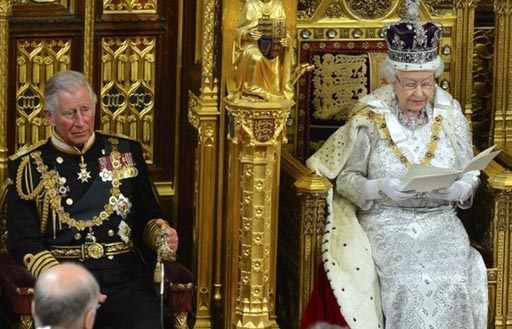 But one thing missing from the discourse was any mention of that king-sized elephant in the room, the EU. No one thought to mention that the reason our MPs have so little to do is because most of our law-making is outsourced to Brussels and beyond. And now, on the day of the Queen's speech, we again get what passes for analysis but, once again, the "limited package" is again seen entirely through the filter of domestic politics. Labour's Chris Bryant claims the speech is so thin it is "practically translucent" (a bit like his underpants). But, its "limited nature”, writes James Kirkup, "reflects the simple fact that we are now less than two years from the next general election. More than anything else, that timetable defines and dictates the Government's agenda". Most of the Coalition's big decisions were made long ago, says Kirkup, and the biggest, on economic policy, was never a matter of legislation. Whatever legislation was needed for major domestic reforms – welfare, schools, the NHS reorganisation – has already been passed. All that remains, he says, is delivery, "actually trying to make those changes work, and make them work in a manner that voters see and appreciate". Yet, as we wrote those few days ago, the European Parliament has rarely been busier, listing on its database 1,301 "legislative acts" so far, for its 2009-2014 session. That is where the action is, we wrote, demonstrating how far the power has drained from Westminster. And just by coincidence, in Brussels on Monday, where the eurocrats were not on holiday, the Commission launched a major new initiative under the working title of "Smarter rules for safer food", a "landmark package to modernise, simplify and strengthen the agri-food chain in Europe". Not least of the measures proposed are those to deal with the fall-out from the horsemeat fraud, but there is a huge range of issues being dealt with, from animal health to the marketing of seeds. Says the Commission, "the current body of EU legislation covering the food chain consists of almost 70 pieces of legislation. Today's package of reform will cut this down to five pieces of legislation and will also reduce the red-tape on processes and procedures for farmers, breeders and food business operators (producers, processors and distributors) to make it easier for them to carry out their profession". But, for the Queen's speech, the nearest we get to dealing with livestock is the announcement of a provision which will lead to an amendment to the Dangerous Dogs Act. The real thing is an EU competence, so this need not concern our media. Despite the massive scale of the EU initiative, it has not been reported in the UK by the national newspapers. Therein lies yet more evidence that the legacy media is writing itself out of the script. It no longer has any pretensions of reporting the news in any responsible way, while its analytical skills have atrophied to the extent that they are producing little that is actually worth reading. COMMENT THREAD Richard North 08/05/2013 |
EU referendum: yet another fine mess
Wednesday 8 May 2013
 When Lady Thatcher died, the piece was temporarily spiked and Lawson instead had a eulogy published. Then, for reasons of its own – not unrelated to Murdoch's increasing dislike of Mr Cameron – the EU piece was resuscitated yesterday, giving the false impression that it was in response to UKIP's performance in the county elections. The Murdoch agenda is now plastered all over the front page of The Times, with the lead story on the print edition declaring: "Voters tell Cameron to cut Europe down to size". Cameron is being warned that he "must scale back Britain's relationship with the European Union to little more than free trade" or risk losing a referendum. The fatuity of this call is matched only by the unhelpfulness of Lawson's call for the UK to leave the Single Market – something guaranteed to bring corporate business to the ramparts in defence of its interests, spewing FUD all over the terrain. But it is also a measure of the intellectual disarray of the Conservatives and media, none of whom seem able to understand that the only way we can possibly "scale back Britain's relationship" with the EU is by invoking an Article 50 notification. Such a straightforward option clearly eludes Mr Cameron, who is now stymied by the rigidity of coalition politics, professing that he "can't legislate for an EU referendum". More than 100 MPs have called on Mr Cameron to legislate in this Parliament, in a letter organised by John Baron, MP for Billericay. But in a reply to Mr Baron dated 30 April, Mr Cameron admits that no such legislation is currently possible. Cameron wrote that the government's legislative programme was founded on the Coalition Agreement which did not include legislating in this Parliament for an "in-out" referendum. For the government to be able to bring forward a referendum Bill, "we would require the agreement of our coalition partners which, as things stand, is not forthcoming", Cameron adds. Most likely, if Mr Cameron requires the assent of his coalition partners to run a referendum Bill past parliament, he would also need their permission to invoke Article 50. That, effectively, condemns him to constructive inactivity. All he can do is promise to stick to his original plan, of giving voters "a proper choice" between "staying in a reformed EU and leaving", with a referendum conditional on the Conservatives winning at the general. However, Simon Jenkins in the loss-making Guardian argues that Cameron should go for a "mandate referendum"and call Clegg's bluff. The one thing Clegg fears more than a referendum on Europe is an early general election, he says. Cameron could argue that he was acting decisively on the expressed wishes of the British people. Which such confusion at the heart of the debate, the way is wide open for an incisive contribution from the leader of UKIP, the only political party dedicated to withdrawal from the European Union. But, instead of that, we get a piece from ten-pint Nigel Farage complaining about "three-pint Eurosceptic heroes", his message doing nothing much more than illustrate that the only eurosceptic party in town still does not have a settled policy on how to leave the EU. No doubt the worst for wear after his rations, Farage is all over the place, demanding a referendum before the general election, without the first thought of how he might win it, or whether, indeed he can. And for want of that, it is evident that he his pinning his hopes on another "stunning victory" at the euro-elections, as if that was actually going to achieve anything of substance. In the absence of any clarity, we thus have to make do with yards of extruded verbal material (EVM) from the media, none of it of any consequence. People tired of living can sate themselves on the ponderous editorial in the Independent, or the blathering of Mark D'Arcy on the BBC website, if only to confirm that a surfeit of quantity does not quality make. Basically, the media, which has never been able to offer any coherent reporting on the issue of European integration, is running to form. The only single mention we can find of Article 50 is here, drowned by the torrent of inconsequential fluff that takes us no further forward. But, if there is one phrase for which the media can be commended, it is in the Financial Times, which tells us that this issue is "not going away". In this, at least, it is right. COMMENT: COMBINED REFERENDUM THREAD Richard North 08/05/2013 |
EU referendum: no chance of winning?
Wednesday 8 May 2013
 To that effect, the paper enlists Peter Kellner, of YouGov – husband of eurocrat Baroness Ashton. He quite rightly ignores any question of a referendum earlier than the general election, and posits whether we will still be a member of the European Union in 2020. In the first of three scenarios, Kellner rehearses the outcome of David Cameron redeeming his promise to renegotiate Britain's membership terms and holding a referendum in 2017. As of 21 and 22 April, a YouGov poll had voters who want to leave the EU comfortably outnumbering those who wanted to stay in, by a margin of 43 to 35 percent. But, he says, whenever Cameron has made the EU a high-profile issue, the gap tends to close. In one poll in mid-January YouGov found more people wishing to stay in the EU than leave it. Then, YouGov asks respondents to imagine that Cameron has renegotiated our relationship with the EU and said that Britain's interests were now protected, thus recommending that Britain remain a member of the EU on the new terms. Asked how they would then vote in a referendum, every time the question is put, those saying "stay in" clearly outnumber those who say "get out". The most recent poll finds a three-to-two majority for remaining in the EU. And in a real referendum, Kellner expects a similar rest. In a Conservative-inspired referendum in 2017, the leaders of all three main parties would advocate a vote for remaining in the EU. They, and much of the business community, would issue dire warnings of how bleak life would be on the outside; only a minority will share Lawson's view that prosperity would be greater if we withdrew. The unspoken "mood" question, says Kellner, would shift from today's "Do you like the EU?" (majority answer: no), to "Is it better for British jobs and prosperity for the UK to remain in the club than risk the hazards of life on the outside?" (probable majority answer in 2017, as it was in 1975: yes). Thus does he conclude that, as in so many referendums round the world, when there is no settled national consensus, the status quo will prevail. The second of the scenarios is where Labour wins the 2015 election and Ed Miliband sticks to his current position of opposing a referendum. There, the consequences are simple. Britain would remain in the EU, at least until after the 2020 general election. In the third scenario, though, Miliband wins the general election having changed his stance and promising a referendum. Cameron resigns and is replaced by a strongly eurosceptic successor. In these circumstances, says Kellner, a referendum fought in 2017 could have a Labour government suffering mid-terms blues up against the main opposition party advocating withdrawal. Then, the possibility of the UK voting to leave the EU would be very real. Alternatively, a Miliband victorious at the general election could call a snap referendum which, in the honeymoon phase of his administration, he could well win. Thus does Kellner conclude that, if the parties stick to their current plans, he sees little chance of Britain leaving the EU. The best chance is of Miliband matching Cameron's promise of a mid-term referendum in 2017. Then, he says, a striking paradox emerges. In those circumstances, anyone whose overriding passion is for Britain to stay in the EU should vote Conservative – while anyone desperate to maximise the chances of quitting should vote Labour – provided Labour has committed to a mid-term referendum. If this is the Kellner view though, under current conditions there is another possibility – that a vote for UKIP at the general ends with a weak Lab-Dem coalition, and an alignment between the Conservatives and UKIP as the official opposition. And that alliance could be strong enough, politically, to force the government into giving us a referendum. But, while events beyond anything but a straight Conservative victory at the general is hard to read, what is very clear already is the europhiles intend to fight a referendum on the FUD (fear-uncertainty-doubt) factor, with the greatest stress on potential loss of jobs. And there, despite Kellner's certainty, a referendum is winnable, if we can neutralise the FUD. If we can show how leaving the EU will not impact adversely on jobs, and can deal with the other factors which the europhiles claim as their own, and can then spread the message effectively, we can beat the status quo effect. However, that means we cannot leave the battle until the start of an official referendum campaign. We need to have a plan agreed and ready as soon as possible, and should be actively fighting the campaign even before the general election. With some years to go, we have time, but only if we do not waste any more of it. Thus, Kellner's analyses are not to be trusted. We know where his true loyalties lie, and they are not with us. And Kellner says we can't win with a Conservative government in place, and – effectively – won't even have a referendum with Labour in place. I say we can win a referendum under the Tories, and can force one under Labour (which we can also win) - but only if we start now, developing and following a coherent plan. And that is, preferably, with UKIP. But, if necessary, we will have to do without. COMMENT: COMBINED REFERENDUM THREAD Richard North 08/05/2013 |
Wednesday, 8 May 2013


 Posts
Posts

