
 The Daily Reckoning U.S. Edition
Home . Archives . Unsubscribe 
The Daily Reckoning | Thursday, March 8, 2012
------------------------------------------------------
“Miracle Eyes” Heal the Blind
In the 21st Century, a new dawn of medicine has emerged that could soon restore the sight of 10 million people worldwide. It’s a medical breakthrough that is unprecedented in human history. In fact, this amazing technology could eventually improve... and extend... every life of every person on earth.
And one tiny California Company, priced under 80 cents per stock, is at the forefront of this revolutionary medical treatment.
Click here to get the full details on this explosive penny stock that could significantly advance the field of regenerative medicine — and possibly make you ridiculously rich.
Perpetual Scapegoat How Market Sentiment Moves With the Greek Debt Crisis
Reporting from Waipara, New Zealand...
Joel Bowman
A couple of hours south of Kaikoura — and the most famous crayfish picnic tables on the South Island’s east coast (Nin’s Bin) — you’ll discover the fastest growing wine region in New Zealand; 80 vineyards sprawling across more than 1,200 hectares of picturesque plantings...
Alas, Fellow Reckoner, there are far less important things to worry about than shellfish and Chardonnay. So, let’s get right to them...
Global markets rebounded yesterday after what had been the steepest selloff of the year on Tuesday. The Dow clawed back about a third of the previous session’s 200-point loss. Indexes in Europe were up too with stocks from the Thames to the Rhine gaining between a half and one percent after Tuesday’s two and three percent losses. For its part, the euro edged higher too...as did oil...and gold...and the outlook for a particularly pesky eurozone financial deadbeat...
The official line when markets (any market, it seems) rally is “optimism surrounding the [latest] plan to solve the Greek debt crisis.” The name of the rescue package changes from bailout to bailout, of course, as do the conduits through which other people’s money funnels, but the general thinking is always the same... “the same” being, oddly, “this time it’s different.”
Predictably, the converse is also true. Whenever markets are in the dumps (as they were on Tuesday), Greece finds itself the convenient whipping boy of elsewhere investors.
How is it, Reckoners must be wondering, that global market movements seem to hinge on the fiscal vitality of a nation that kicks in just 2.4% of Europe’s total GDP? Surely there are Black Swans with far bigger wingspans to concern ourselves with, no?
By the time you read these words, news about the latest, €130 billion Greek debt deal will be fish and chip paper here in Australia. Old news, in other words. The conjecture and guesswork will have been settled, one way or another. Markets will have responded accordingly...and neckties on the television will be reading their cue cards and acting like they knew what was going on all along.
But, as our colleague Dan Denning explained in these pages recently, “Greece isn’t about saving Greece.”
As usual, there’s more — much more — to the story. So, what’s at stake here?
“The only reason something so small and insignificant could matter so much,” observed Dan, “is that it matters in a way no one is willing to say.”
Do tell, Mr. Denning...
“It’s about the subversion of sovereignty and democratic processes by removing decisions from people and giving them to trans-national financial elites. It’s about preserving a global system that’s based on the accumulation of debt and growing government power because there are two groups of people who benefit tremendously from that system, even if most people don’t.”
But isn’t the rescue package about debt reduction? Isn’t it about maintaining the integrity of the euro currency and viability of the eurozone itself?
C’mon, Fellow Reckoner. This isn’t our first Zeibekiko. We’ve all danced these steps before.
Not only is the euro better off without Greece, Greece is surely better off without the euro too. It’s a mutually-abusive, hate-hate kind of relationship; the type you wouldn’t want even your closest frenemy to suffer through.
“With its own currency,” observed Dan, “Greece could default, devalue, inflate and start over. Argentina did it in the last 10 years. It’s not rocket science.”
So too did nations from Austria to Zimbabwe (and those starting with almost every letter in between) default during the past century. If the likes of Guyana and the Solomon Islands can manage it, then why not Greece?
Moreover, had Europe simply cut the Zorbas loose when they strayed from their expressed commitments, as outlined under the Maastricht Treaty, the EU might have maintained some credibility in its own fiscal responsibility.
No. Saving Greece is not about saving the euro. Nor can a plan to reduce debt to “only” 120% of GDP...over the next eight years...be taken seriously as a motivation for keeping Greece tethered to the union.
Concludes Dan, “This is simply the latest example of corrupt government operatives colluding with the financial elite to steal money, liberty and big chunks of ‘the pursuit of happiness’ from ‘we, the people.’”
(If you missed Dan’s complete and insightful write-up, you can read it here.)
But are you really shocked, Fellow Reckoner? Even mildly surprised?
Whichever way markets go this morning — and tomorrow...and for the foreseeable future — one thing is certain: Those who write and enforce the rules are not in the habit of leaving unwell enough alone. Capitalism — both the creative and destructive forces therein — must be contained, controlled and contorted, they contend.
Anything to prevent the insiders from becoming the very outsiders they affect to serve.
Addison Wiggin has more on these vital and complimentary market processes in today’s feature essay, below... A Potential Fortune for Your Family’s Future Generations Hangs in the Balance... 
The wealth curve is “going vertical”. Find out what this means — and how you can take advantage of it today.
Click here.The Daily Reckoning Presents To Die and Let Live
American civilization has become much more civilized during the last hundred years. In the process, ironically, it has become much more savage toward capitalism and free enterprise.
AddisonWiggin
One hundred years ago, most folks accepted adversity as an unavoidable facet of life. Childbirth was a high-risk endeavor. “Old folks” died at 50. Dysentery claimed more lives than heart attacks. Businesses failed. Governments defaulted. Currencies crumbled.
But not anymore. We are more civilized. Childbirth has become a low- risk endeavor and old folks live long enough to have a heart attack in their 80s.
American civilization has achieved a stunning number of medical breakthroughs during the last century — adding about 28 years to the average lifespan in the process. Unfortunately, American civilization has also devised a stunning number of mechanisms to extend the lifespans of ailing financial institutions and brain-dead corporate entities.
As our civilization has aged, it has become obsessed with erecting economic guardrails, stringing safety nets, straightening curves and legislating Bubble Wrap around almost every conceivable mishap. As a result, the financial system is so thoroughly insulated with regulations and “protections” that it is suffocating.
As a nation, we have become intolerant of any economic adversity...even when that adversity serves an essential economic purpose. We want our summers without any winters. We want our victors without any vanquished. We want our successes without any failures.
That’s not good news for free enterprise. Defaults and bankruptcies are staples of economies that flourish over the long term. “Capitalism is not just about success — that’s the easy part,” observes James Grant, editor of Grant’s Interest Rate Observer. “It’s also about failure — recognizing it, dealing with it, liquidating it, properly pricing it.”
Schöpferische Zerstörung means “creative destruction” in German. In America, we have forgotten what it means. Thanks to the Federal Reserve and other destructive creations of government, the process of creative destruction rarely takes root in American soil anymore.
“At its most basic,” Wikipedia explains, “‘creative destruction’ describes the way in which capitalist economic development arises out of the destruction of some prior economic order...From the 1950s onward, the term ‘creative destruction,’ sometimes known as ‘Schumpeter’s gale,’ has become more readily identified with the Austrian-American economist Joseph Schumpeter, who adapted and popularized it as a theory of economic innovation in Capitalism, Socialism and Democracy (1942).”
The destructive portion of “creative destruction” plays a vital, therapeutic role. But the financial leaders of the US and the eurozone have zero appetite for creative destruction. Instead, creative denial is the order of the day. They pump trillions of dollars of fresh credit into insolvent banks like embalming fluid into a corpse. But the fresh credit rarely revives these financial corpses. It simply enables them to keep hanging around and stinking up the place.
The Federal Reserve should ditch its embalming fluid and buy cement instead. If the Federal Reserve were genuinely serious about reviving long-term economic growth, it would be fitting America’s big insolvent banks with “cement galoshes” and tossing them into the Hudson.
That’s because creative destruction is not just about destruction; it is primarily about creating the investment opportunities that result. When ventures fail, a new generation of capitalists can enter the fray to make the next generation of fortunes.
That’s how the world works...or at least how it should work. The recent history of sovereign defaults and currency devaluations illustrates this phenomenon very clearly.
Within a few years of a default or devaluation, most countries embark on a robust new growth phase. The process is not easy or painless, but it is extremely effective in clearing away the rot so that new ventures can flourish.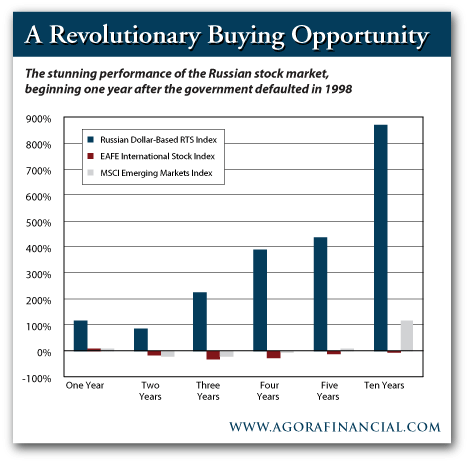
The Russian government defaulted in 1998. An investor who allowed the dust to settle a bit but then purchased stocks exactly one year after the default would have doubled his money in just one year. After three years, the gain would have been more than 200%. After five years, more than 400%.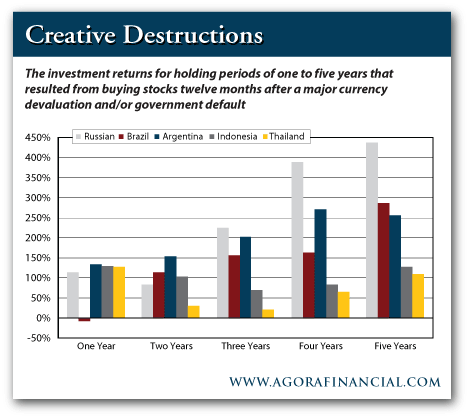
This hypothetical example is not an exception: It’s the rule. An investor who purchased stocks one year after the 1997 Thai baht devaluation, 1997 Indonesian rupiah devaluation or 2002 Argentine peso devaluation would have more than doubled his money during the ensuing 12 months in each instance.
The Brazilian default of 1990 was an exception. An investor would have lost money initially. But within a couple of years, that investment would have paid off handsomely as well.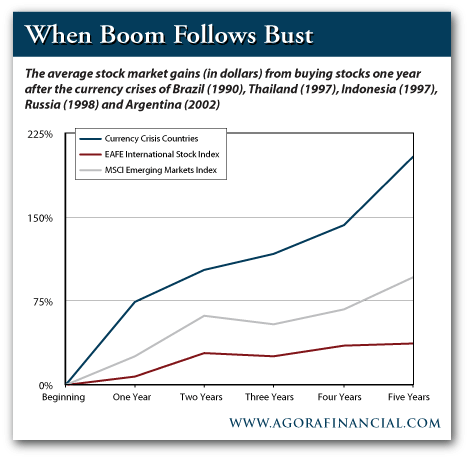
As the charts show, these five “crisis buys,” on average, would have doubled an investor’s money after two years and tripled it after five years — dramatically outperforming the benchmark international and emerging market indexes over those time frames.
The message is clear: Destruction can be very creative.
Regards,
Addison Wiggin,
for The Daily Reckoning
Joel’s Note: Big picture trends and how to profit from them. That’s Addison’s beat in his Apogee Advisory service. But before the mother of all profit opportunities comes along, expect the mother of all bubbles to burst first. What are we talking about? Addison explains in this presentation.
---------------------------------------------------------
Here at The Daily Reckoning, we value your questions and comments. If you would like to send us a few thoughts of your own, please address them to your managing editor at joel@dailyreckoning.com Little-known “loophole” could triple investing income
In 1986, Ronald Reagan signed a little-known “loophole” into law.
Today, the special “10-86 Payback Plans” it created are allowing some Americans to collect as much as three times the income that regular bonds and stocks pay.
We’re talking solid yields — without even touching the stock market.
Click here now for all the details.
Thursday, 8 March 2012


 Posts
Posts

