

EU politics: no benefit of the doubt for Cameron
Saturday 5 January 2013
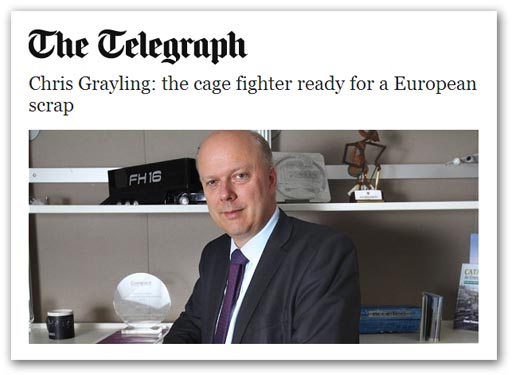
Chris Grayling, interviewed in The Daily Telegraph today, argues that David Cameron should be supported on his stance on the European Union. And in so doing, he encapsulates the very reasons why so many people will not support him.
Only someone completely detached from reality, for instance, would think it sensible to argue how important it is, as Grayling does, that "if we're setting down a path towards renegotiation that people get behind David Cameron and give him the benefit of the doubt …". One really does have to wonder at what is going through Grayling's head here. If one had to choose one theme that dominated contemporary political discourse, it would have to be the growing lack of trust in the political classes, and the strengthening of the anti-politician mood. Alongside that, we also see a very significant resentment directed personally at Mr Cameron, for his refusal to arrange a referendum on the Lisbon Treaty, and his "dance of the seven veils" on the European Union question has done little more than irritate and frustrate in equal measure. Summing it up, the Scottish Herald recently wrote of "Cameron's crass EU game, observing that he was offering "the worst of both worlds, tantalising his malcontents and preaching the national interest simultaneously". On top of this, there is a very significant constituency which does not accept that treaty renegotiation is a realistic or genuine position, suspecting with good cause that Cameron is seeking to fend off pressure to withdraw from the EU by fobbing us off with a mirror version of Harold Wilson's 1975 referendum. It is in this atmosphere of distrust and suspicion, that Grayling's comments must be seen. For him blithely to demand of us that we give Mr Cameron the benefit of the doubt is so incredibly unrealistic that it borders on the arrogance. Mr Cameron has used up what little stock of trust he ever had, and it is now for him to recover the situation of his own making. His speech will be a huge test of his good faith, and the text will be picked over and examined in detail. No one is in the mood to give him any benefit of the doubt. That was long ago exhausted. But when we come back to Grayling, he claims that Conservative supporters switching their allegiance to UKIP risk handing the next election to Ed Miliband. "I think all those who are tempted to say, 'oh well, you know if we just went off and voted UKIP it would some how make a big difference' … I think they’re making a fundamental mistake. They risk gifting the leadership of this country in what will be a crucial period to the Labour Party". He goes on to say: "The Labour Party that signed up to the Lisbon Treaty, that promised we would not end up in the position we're in, promised a referendum and then welshed on it and just signed up anyway". The Labour Party, he asserts, "cannot be trusted with Britain's interests in Europe and anyone who is interested in doing anything else than getting behind David Cameron on this issue is making a big mistake". This is all very well and good, but he neglects to say that Cameron also offered a referendum and also welshed on his promise, then relying on the fine print of his promise to justify his actions. It is convenient, in this context, to rely on Cameron's promise in The Sun in September 2007, but there were no caveats in his promise on 26 May 2009 in his speech on "Fixing Broken Politics". "A progressive reform agenda", he said, "demands that we redistribute power from the EU to Britain and from judges to the people. We will therefore hold a referendum on the Lisbon Treaty …". The unalterable fact is that Cameron made a promise, and he broke it. He cannot change that, and in so doing he lost any right to claim our trust. Grayling should know better than to ask for it now.
As much to the point, for the many of us who recognise that the European Union has become the supreme government of the United Kingdom, warning that a vote for UKIP will let in Labour holds few terrors. It might be desirable to have a Conservative government if one was on offer, but our government is in Brussels. Only when we are rid of that will it matter whether which local party gets into power.
After all these years, though, Grayling and many other senior Conservative politicians still don't really understand this, and what motivates the UKIP voter. Leaving "Europe" aside, they say, a Conservative government would be far better than Labour, and by voting UKIP, you risk letting them in. But the counter – from an increasing number of people - is that you cannot leave "Europe" aside. Until and unless you deal with the European Union, there is no deal. A vote for the Tories is a vote for Brussels, just as a vote for Labour is a vote for Brussels. There is no substantive difference. "Who cares wins?" we say. For sure, it is only a relatively small number of people who think that way, but that number is enough to cost the Conservatives the next election. And asking us to give Cameron the benefit of the doubt is not going to cut it. Either he sorts "Europe" or he is history. There is no middle way, and no benefit of the doubt. COMMENT THREAD Richard North 05/01/2013 |
EU politics: a Polish alliance in the offing?
Saturday 5 January 2013
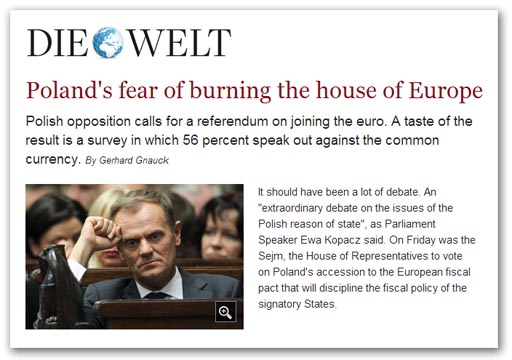 Furthermore, after an "extraordinary debate on the issues", the parliament has postponed until February a vote on Poland's accession to the European fiscal pact, after it lost confidence in its ability to win it. The opposition, which had threatened to boycott the vote, claimed that the pact was "harmful to Poland, for Polish entrepreneurs and unconstitutional". As to the euro, prime minister Donald Tusk had warned parliament in December that : "In front of us is the decision whether to be a part of this heart of Europe … or whether we are a marginal state its own currency". The country must determine in the coming months its line of approach, he said, "otherwise the train leaves without us." Thus we see the same old rhetoric, which seems to have international application. The Polish propaganda is no more imaginative than that served up by our own europhiles. Die Welt, however, observes that the Polish "euro-date" is getting to be like a mirage. When the country joined the EU in 2004, there was talk of 2009. Then, in 2008, prime minister Tusk postponed the date to 2011. Then along came the eurozone crisis, alongside the remarkable success of the Polish economy and the strength of the zloty.
Leader of the opposition party PiS, Jaroslaw Kaczynski, criticises the decision to seek entry to the eurozone and a spokesman for the national conservatives says: "If a house is on fire, you don't go rushing into it". He adds that the EU is also presenting member states with other projects, "which would mean an almost complete loss of economic sovereignty". Poland was in danger of "losing something we have won recently. There was no reason to give it up".
PiS MEP Krzysztof Szczerski emphasises that the Poles voted in 2003 to join the EU, but not on the accession to "a quasi-federal organism to which is now the euro zone". "Only when we are able to compete with the EU countries, would the introduction of the euro be good for us" says the foreign policy expert Leszek Balcerowicz, and that could take a while. It could take 20 years for Poland to reach the standard of living in Germany. On the other hand, ex-Foreign Minister Dariusz Rosati argues that failure to join the euro annually costs 20 to 25 billion zlotys" - the equivalent of about five to six billion euros, an assertion that hasWelt telling us that the European project is "controversial". Even the controversial EU constitution would have gained a majority but the euro will only get minority support. The government, it says, will have to proceed more carefully. Before anything can happen though, the constitution has to be changed, because the federal bank has been enshrined as the only body that can issue currency. However, this will require a two-thirds majority in parliament, which currently is not available. Thus, the government is going to have to wait until the election in 2015. Then there will be two years in the "waiting room" in the ERM II. Thus, the earliest the euro could be introduced is 2018. This leaves plenty of time for further introspection, with the ultimate decision resting on whether "anxiety in Poland gets the upper hand". But a lot can happen in five years. The EU could be a very different place then and, with Poland still on the "periphery" we could have in that country a more secure alliance than we were able to offer in 1939. COMMENT THREAD Richard North 05/01/2013 |


 Posts
Posts

