

EU politics: budget veto on the cards
Wednesday 6 March 2013
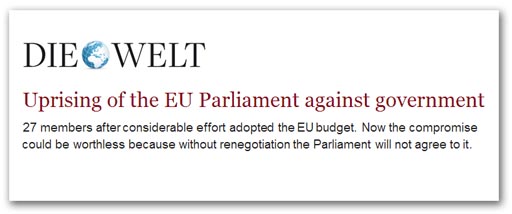 This, the paper claims as an "exclusive" and that it may be, although the Irish Independent was forecasting problems last week. Nevertheless, we have heard very little recently about the budget from the British media, even if EP rejection was always on the cards, kicking another of Mr Cameron's great victories into touch. Parliament president Martin Schulz, we are told by Welt, has had initial exploratory talks with the Irish EU Presidency and the European Commission and has demanded that the Council should agree to a "package of demands". This includes a "mandatory mid-term revision of the budgetary framework" by the Parliament and the EU Commission. There will be an insistence on a "legally binding resubmission" to be enshrined in the Finance Act. Herbert Reul, Chairman of the CDU/CSU parliamentary group in the European Parliament is also demanding more flexibility in reallocating individual budget items. He wants surpluses to "be transferred automatically into the next financial year". Another demand is for the reallocation of funds within the budget, and the Parliament thus demands "comprehensive negotiations" with the Council. Negotiations could include aspects that were not part of the Council decision. The test of whether the EU leaders are ready to return to the negotiating table will come the by the end of the week following the plenary session in Strasbourg, when they meet in Brussels for European Council meeting. This could be a testing time for the "colleagues" as it was difficult enough for them to reach an agreement in the first place. As for Mr Cameron, the very last thing he needs is for his budget "triumph" to unravel. COMMENT THREAD Richard North 06/03/2013 |
EU legislation: blundering in the dark
Tuesday 5 March 2013
 Typical of the pack's offering is the Telegraph's headline, "Osborne faces clash over bank bonus cap at talks with EU finance ministers", framing the story in terms that the lame hacks can understand – the "battling Brit" versus the rest of the European Union. This child-like pastiche is as far as the media can go, as their lamentable ignorance prevents them understanding what is going on. Even Reuters, whose journalists lay claim to the possession of some brain cells (even if they are rarely used), don't seem to be capable of navigating their way through the Brussels morass. They wrongly assert that Osborne today had a chance to "challenge plans in Brussels to cap bankers' bonuses". Nevertheless, in another of the agency's reports, we have an apparent corrective to theTelegraph's trivialising biff-bam approach, telling us that Osbonne has no chance of getting a change to the status quo, citing Ireland's Finance Minister, Michael Noonan, as its source. Irish ministers, of course, have special status here, as Ireland currently holds the presidency of the EU's Council of Ministers. But what we don't get from Noonan is precisely why Osborne is whistling in the wind. Actually, it is quite possible that Noonan doesn't know anything beyond the framework in which he operates. The system is indeed complex, and one finds that even senior cabinet ministers in the British government have a very limited grasp of the EU's procedural rules. At the highest level this applies, as time and again David Cameron has shown himself ignorant of the EU's procedures. But the reason Osborne could not prevail today at the finance ministers' meeting was because there is no procedure which would allow him to do so. The ball did not rest in the Council's court, as the next move belongs with the European Parliament. As we discussed on Sunday, this is dictated by the EU's ordinary legislative procedure (formerly known as the co-decision procedure), the nature of which seems to defeat the entire corps of journalists and indeed most of the Member State politicians. The journalists' mistake seems to stem from their insistence in treating the European Union as a homogeneous body, instead of a series of (often warring) institutions – and then (in the British camp) to treat the UK as if it were somehow separate from the EU instead of an integral part of it. Failing to make the distinction between the EU as a whole and its institutions, the hacks are thus unable to appreciate that we are witnessing a power struggle between the European Parliament – strengthened by the Lisbon Treaty – and the Council of Ministers, representing the Member States. This is an interesting development, the subtlety of which evades the average hack, as the traditional struggle was always between the European Commission and the Council (of Ministers). But now the European Parliament (EP) is emerging as a powerful player in its own right, challenging both the Commission and the Council. Those, incidentally, who still dismiss the EP as a "toy" parliament, without power, are out of date. The Lisbon Treaty substantially altered the balance of power, and this institution is beginning to flex its muscles and make a real impact on the legislative scene. Thus, as we partially explained on Sunday, what we have is the EP's Economic and Monetary Affairs Committee, through its rapporteur Othmar Karas, drafting an amendment to the Commission's proposal, which imposes a cap on bankers' bonuses. On Sunday, I was unable to find the original amendment – assuming therefore that it had yet to be formally tabled. But it was there. The reason I could not find it was one of terminology. While the media at large (and the politicians) are referring to "bonuses", the amendment was couched in terms of "variable remuneration". Once this is understood, the rest becomes clearer. Karas's amendment was actually approved by the Economic and Monetary Affairs on 7 March 2012, but what we see is the cap on bonuses set (as is the current proposal) of no more than the fixed salary, but a requirement that they should not exceed two times the fixed part. However, this basic amendment then attracted rival and more severe amendments, not least from the Greens, limiting total remuneration to "three times the salary of the head of the respective government" or no more than "thirty (or twenty) times the average remuneration of the lowest paid five percent of employees". One amendment even capped total remuneration to €500.000 while another banned bonuses altogether, for bank directors. Yet another limited bonuses to 50 percent of fixed remuneration. Thus, the EP was facing a situation – which is not untypical – where a series of rival amendments were to go before the plenary, from which only one could emerge, and where no single amendment could command majority support. Here started the horse-trading that is not in the rule books, and which you will not see written up in the text books. At this point, one has to understand that the EP was arguing over the committee report, which was to become the submission to the parliament as a whole, from which was to emerge the parliament's "common position".
But then the situation became even more complicated, as the Council, alarmed that one of other of the more extreme amendments might emerge – or that there might be no amendment at all – convened a series of "trialogues".
This is what has confused the poor journos, as these are entirely informal talks between the Council officials (COREPER), the Commission and members of the EP's Economic and Monetary Affairs Committee, including Karas. Officially, these trialogues (sometimes called "trilogues") don't exist formally. They only appear in therules of procedures and the informal guidance as informal meetings. Thus, they cannot make formal agreements. But it was at the final trialogue that the parliament agreed to rationalise its amendments and get behind a new amendment, proposing that bonuses should not exceed fixed remuneration – a 1:1 limit. And that is why, today, Osborne did not have a vote. There is no formal agreement to vote on, within the framework of the rules. Nothing now can happen until the EP votes on a consolidated amendment which emerged at the trialogue, provisionally set for 17 April. Then, and only then, does the parliament adopt its position - which may or may not include the bonus cap, depending on how the MEPs vote.
Thus, as today's Council report makes abundantly clear, neither the bonus issue nor any other matter "can be considered as finally agreed until an overall accord on the package is reached".
Under the current procedure, that "accord" requires, in the first instance, the EP position to be agreed and then communicated to the Council. Only at that stage does the amended proposal formally exist - given that it has attracted majority support from the EP. Then, and only then can the Council discuss and vote on whether it agrees with the parliament. On this basis, the very idea that there would be a showdown today was a complete misrepresentation of the process – an ignorant fantasy on the part of the media. Osborne has gone away frustrated, as was always going to be the case. He must wait his turn. COMMENT: "BONUSES" COMBINED THREAD Richard North 05/03/2013 |
Climate change: the invisible global warming
Tuesday 5 March 2013
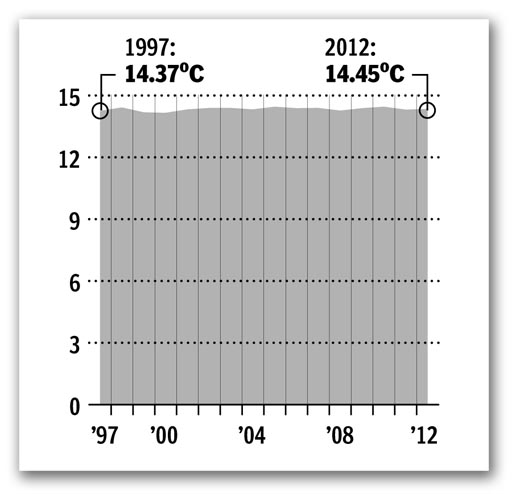 And if you think the flatlining represents proof that global warning has stopped, you are very silly people. Those clever scientists at the University of Colorado Boulder have found that the real reason is volcanic eruptions releasing tons of sulphur dioxide into the atmosphere. So there you are – we still have global warming, but it is being temporarily suppressed by a volcano-induced increase in the "optical thickness" of the stratospheric aerosol layer. This allowed less sunlight to reach the surface, and therefore lowered the temperature. The only problem is that, it there is global warming, but it isn't showing, that surely means that there can be no detectable effects from the non-existent global warming. And if that is the case, how come all that "extreme weather" is being blamed on global warming? After all, if the temperature isn't going up, there can't actually be any temperature-induced weather effects, in which case this "extreme weather" can't be attributable to global warming. Or is that too simple for us mere mortals to understand? COMMENT THREAD Richard North 05/03/2013 |
UK politics: the joys of representative democracy
Monday 4 March 2013
 It takes Jon Snow in his error-strewn Snowclog to represent the broadcast media. He observes that the government, "so keen to test public opinion on Europe", would never brook such a test of public attitudes to banking remuneration and working practices in the UK. The Swiss, he says, have often been ridiculed for their love of referendums. Not any more. Certainly, in Germany, there is no ridicule. The media give the referendum full coverage, many newspapers offering several stories, while the politicians have been quick to react, sparking a vibrant debate. Thus, Handelsblatt led on SPD Vice Joachim Poss, retailing a report from Neue Osnabrücker Zeitung, which had him saying, "The referendum is an important step in the right direction to meet the rip-offs in management elsewhere". Such is the emasculation of the German political classes, though, that Poss, instead of calling on the Federal Government to introduce a new law, called for an EU Directive, perhaps oblivious to Article 153(5) of the Treaty, which makes it clear that the EU cannot legislate on pay. But, when it comes to views of the referendum result, though, even the CDU economist Michael Fuchs approves. According to Die Zeit he is happy that salary decisions should not be taken by the state. "The shareholders know exactly what they can afford", he says. Green party leader Jürgen Trittin said that Switzerland was "a model for the compensation excesses in the financial sector" and wanted stricter rules in Germany would "stricter rules" are introduced. Sahra Wagenknecht, deputy parliamentary leader of the Left Faction asked Germany to take action. Her country, she said, was "a paradise for executives, undermining the merit principle". The North Rhine-Westphalian FDP chairman Christian Lindner criticised the multi-million bonuses paid by Deutsche Bank, calling for "a sense of responsibility". That was echoed by economist Michael Huether from the Institute of the German Economy in Cologne. While welcoming the public debate, his view, "instead of more laws, we need more boards of directors and board members who take personal responsibility". But it is precisely because the "thieves in suits" are devoid of any sense of personal responsibility that the people of Switzerland felt impelled to act. And, it appears, they haven't finished yet. Piggy-backing on Minder's success, the Swiss Young Socialists are campaigning to prevent executives from being paid more than twelve times the wage of their lowest-paid employee. A referendum on this is expected in the second half of this year, the group says. That formula would be particularly appropriate to the public sector, with a complete prohibition on performance bonuses, non-contributory pensions and excessive payoffs. But what a contrast we are seeing. While the Swiss people are able to force action, we are forced to rely on laborious progress of Mr Pickles, doing very little very slowly. Such are the joys of representative democracy. No wonder the British media, guardians of the status quo, are reluctant to talk about it. COMMENT: "BONUSES" COMBINED THREAD Richard North 04/03/2013 |


 Posts
Posts

