
Chávez's heir apparent, Nicolás Maduro, has a challenge
CARACAS, Venezuela — When the news came of Hugo Chávez's death, it was delivered by the man he selected as his heir, Vice President Nicolás Maduro.
Chávez anointed Maduro, a former bus driver, his successor before leaving for Cuba and his fourth operation for cancer in the past 18 months, but whether Maduro can lead the socialist revolution Chávez created is in question.
Venezuelan Foreign Minister Elias Jaua said Tuesday that Maduro will be interim president in the wake of Chavez's death and run as the governing party candidate in elections to be called within 30 days. It was not clear when elections would be held.
Chávez's term ended Jan. 10, but he was in Cuba and apparently was not sworn in to a new term.
Chávez loyalists and his regime leaders face the dilemma of inheriting a government whose strength is due largely to love for Chávez, not the regime. Now that Chávez is dead after 14 years in office, Maduro will have to convince Chávez's supporters that he is capable of carrying Chavismo beyond its personality cult foundation.
"Maduro would probably lose right now between 40% and 50% of the people who voted for Chávez in the October presidential elections,'' said Tarek Yorde, a Caracas-based political consultant, prior to the death announcement. "He's a president in training."
Chávez had not been seen since Dec. 11. Before his illness, he was known for speaking hours on end in speeches. His claim to be the savior of the poor and folksy speaking style inspired an almost messianic devotion carefully massaged by the state-controlled media.
Maduro, 50, seems ill at ease in public. He has taken on a partisan tone in speeches as he tries to maintain unity among various factions in Chávez's United Socialist Party of Venezuela (PSUV).
"I have my doubts about whether Maduro can unite these diverse constituencies (in the PSUV) to the same degree as Chávez," said Nikolas Kozloff, a political analyst and author of Revolution! South America and the Rise of the New Left."He is one of the working class but I'm not sure he commands a lot of following within the armed forces."
Unlike Chávez, who was a former paratrooper and officer, Maduro has no military experience. He came to Chávez's attention when as a union leader he helped Chávez win release from prison following a coup attempt. He is close to Cuba's Castros as is Chávez, and was named foreign minister after serving as president of the National Assembly.
Maduro has already provided one example of the difference between himself and Chávez. He took 10 minutes to give this month's state of the union address in Chávez's absence. Chávez delivered a 10-hour oration last year.
"Look at where he's headed, Nicolás, the bus driver! How the bourgeoisie laughed at him!" Chávez said as he appointed Maduro, then foreign minister, as his successor in December just before flying to Cuba for surgery on an undisclosed cancer.
Alberto Barrera Tyszka, who co-wrote Without Uniform, a biography of the president, says Chávez has always exercised an egocentric leadership that Maduro lacks, which means no one can predict how he would rule.
Chávez, Barrera said in an interview before the death was announced, is "surrounded by people who are less prepared and less effective," and Maduro is the least independent of Chávez's inner circle.
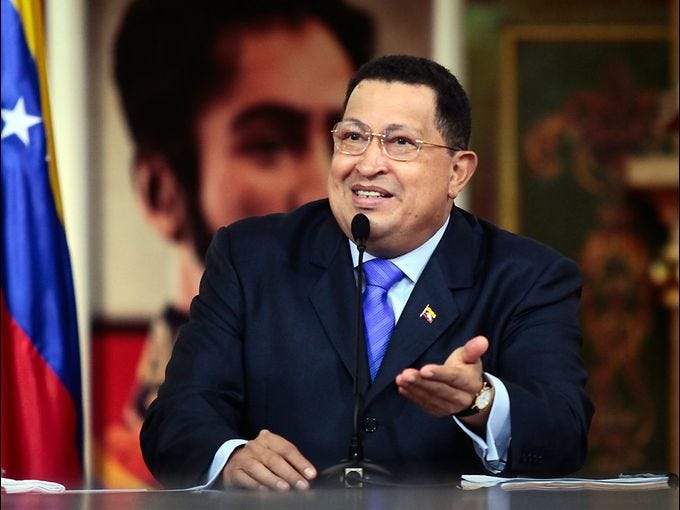
Venezuelan President Hugo Chavez speaks at the presidential palace on Oct. 13, 2012, in Caracas. Miguel Angel Angul, AFP/Getty Images


Maduro started in politics as a bus driver, representing workers of the Caracas Metro when unions were banned. He was a supporter of Chávez's unsuccessful coup in 1992 and helped win his release from prison in 1994. His wife, Cilia Flores, is a lawyer and Venezuela's attorney general who defended Chávez in court.
Chávez picked Maduro as one of his campaign operatives for his successful presidential election in 1998. Maduro won a seat in the Venezuelan Congress in 2000 and 2005. In 2006, Chávez named him his foreign minister.
"Maduro has a strong relationship with Chávez, but also with the Castros (in Cuba)," Barrera said.
That link to Cuba has worried many members of Venezuela's opposition.
"The capital of Venezuela has moved to Havana," said Leopoldo López, a prominent opposition leader who is banned from taking political office here.
In a sign of how well he takes criticism, Maduro hit back at opponents and threatened "forceful actions" should the opposition not "watch (its) words."
The ever-faithful Maduro was appointed deputy to the National Assembly in 2000 before becoming its president. He left no doubt where his aims lay then.
"The contribution of this new assembly will be to strengthen the revolution, to legislate so that Chávez governs not until 2021 but until 2030," he said. Four years later, the assembly stripped presidential term limits from the constitution.
As foreign minister, a job he held until early January, he carried out some of Chávez's more questionable diplomatic policies, such as alliances with Syria and Iran. On the other hand, he has also warmed relations across the region, notably with Colombia, which was threatening war with Venezuela over Chávez's backing of communist guerrilla fighters there.
Colombian President Juan Manuel Santos said last week that he was "optimistic" should Maduro come to power.
Diplomats describe Maduro as more pragmatic than Chávez, owing to his trade union background as opposed to Chávez's military history. Venezuela's former ambassador to Mexico, Vladimir Villegas, expects relations to warm somewhat.
"He's always followed Chávez unconditionally, but not because he's not smart enough to do otherwise," he said.
Maduro seems to have the same low opinion of the United States that his boss did.
President Obama "ignores the reality of our country," he said, speaking at the Summit of the Americas last year. "Sadly, he has inherited the cynicism and perversion of George W. Bush."
Whether Maduro can step into the job is in question. Chávez's term ended Jan. 10, and the constitution said he must be sworn in to a new six-year term that day by the National Assembly or the Supreme Court. The Supreme Court ruled he could be sworn in at a later date but it is not known whether that was done properly.
The country's opposition movement led by former governor Henrique Capriles Radonski, who lost to Chávez in October, has said any attempt by Maduro to take over would be unconstitutional. In any event, Capriles has said he does not think Chávez's regime can survive the death of its leader.
"I have my doubts about Chavismo without Chávez,'' Capriles said in an interview withEl Universal newspaper. "Any leadership without Chávez appears to me to be profoundly vulnerable."
Meanwhile, Venezuela's economic woes are mounting.
During the presidential campaign, Chávez ramped up social spending, depleting international reserves and widening the fiscal deficit to about 12% of gross domestic product. Imports have fallen, and people are seeing shortages of basics such as coffee, sugar, corn meal, margarine, cooking oil and meat.
Venezuela's bolívar is losing value. An official devaluation that would allow the country to pay off international debts by printing money could cause massive inflation. The black market rate ranges from between 15 and 20 bolívars for one $1.
However, rising prices for consumer goods would cut into the regime's support among its most ardent loyalists, the impoverished.
Despite the problems left by Chávez for Maduro, analysts say he is the odds-on favorite to succeed Chávez because he has his blessing and the resources of the United Socialist Party of Venezuela. The party can exploit the proceeds of the oil industry to pay for social programs and propaganda efforts; the opposition had a poor showing in gubernatorial races in December and has few funds.
"Who could have imagined Chávez as president in 1998?'' said Miguel Tinker Salas, a professor of Latin American history at Pomona College in California and the author ofThe Enduring Legacy: Oil, Culture and Society in Venezuela. "Reality has a way of changing our perception of what is possible."


 Posts
Posts

