

Horsemeat fraud: Europe-wide investigations stall
Saturday 11 May 2013
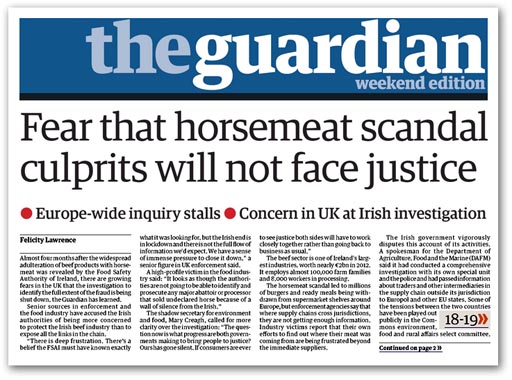
The agri-food industry is the second largest economic sector in the European Union, employing over 48 million people and is worth some €750 billion a year. Of that, one of the most valuable sectors is the meat industry, marketing high value products which form the basis of massive, secondary food processing industries.
The horsemeat fraud affair shone a bright light into the more unsavoury corners of these industries, and it is now unsurprising that the major players are not too keen on even further scrutiny, especially by a properly structured official inquiry, staffed by people who know what they are looking for, and have some understanding of the industry. It is a measure of how far the issue has slipped down the political agenda, though, that only the loss-making Guardian is reporting on how the inquiry process seems to have stalled – in part due to the intransigence of the Irish (where there are major criminal elements in the meat industry), and partly due to high-level political interference in the setting up of the inquiries. Add to this the incompetence of the House of Commons EFRA committee, chaired by former euro-luvvie Anne McIntosh, and you have an issue which is sliding into obscurity, with many of the problems that gave rise to the horsemeat affair entirely unrecognised and unresolved. Bizarrely, even though the necessary scrutiny has not yet taken place, the European Commission isalready acting, coming up with proposals to make financial penalties directly related to profits from "fraud", and mandatory spot-check testing. Neither of these proposals will have any effect on food fraud in general, an industry in its own account, which has become a vast, multi-billion criminal enterprise with a global reach. And it was of this that we were catching a glimpse during the height of the horsemeat scandal. So far, though, with at least 4,000 samples of meat have been tested, and millions of pounds-worth of food having been taken off sale – much of it destroyed – only three people have been arrested, and there are no major prosecutions in the offing. To that extent, the Guardian's concern is merited – expect that, like the rest of the British media, it has not thought to comment on, or even report, the Commission initiative. It really is quite stunning that what amounts to a major legislative programme, affecting the entire agri-food matrix, is being entirely ignored by the media. In a way, though, this is understandable. Since food regulation (and food policy in general) is dictated by Brussels, there is little British involvement in the legislative process. And nor can inquiries hope to do very much without factoring-in the European (and global) dimension, over which they have no jurisdiction or reach. Thus it is that the involvement of Brussels has sucked the life from an area of policy which once had the capacity to galvanise the nation and bring down governments. Now it is simply the minority interest of a loss-making newspaper which sees the potential for making mischief around the edges, as long as it doesn't dig too deeply. COMMENT THREAD Richard North 11/05/2013 |
EU referendum: the seeds of betrayal
Saturday 11 May 2013
 He has pledged an "in-out" referendum if he wins the election, but not until he has tried to renegotiate the terms of our membership to make them better reflect the interests of the British public. If he succeeds, he clearly believes Britain would be better off in the EU than out.There you can see the future. All that has to happen is that Mr Cameron shows the requisite "leadership" and the paper will roll over and back its man. Like the rest of the British media, when Cameron comes home with the "deal", it will buy into it and support the "yes" vote. Richard North 11/05/2013 |
Local government: protests at restraints on looting
Friday 10 May 2013
 The contrast is more than a little interesting. On the one hand we have yet more examples ofwholesale looting by local government – with my local authority alone sharing £1.3 million between the top nine officials – part of a bill exceeding £3 billion for these over-paid town hall bureaucrats. On the other, we have an attempt by central government to allow the public to limit the power of councils to pick their pockets – only for "council leaders" to "react furiously" to the plans. At the heart of the "row" is the Local Audit and Accountability Bill, which aims to stop local authorities bypassing the requirement to call referendums if they plan to increase Council Tax by two percent or more. What they have been doing is top-loading the precepts, increasing those rather than the core tax, which means that the total sum can increase by more than two percent without the need to call a referendum. Showing absolutely no remorse on behalf of his members, Sir Merrick Cockell, chairman of the Local Government Association, simply complains that it was "inconsistent" for the government to subject council tax rises to a local referendum, when nationally-set taxes such as VAT are not. These, he said, "have a much greater impact on people's income than council tax, and the public was not directly consulted over those". If Cockell has a point, however, there is an obvious answer to his assertion that it is "unfair" for the government to apply different rules for council tax hikes than it does for national taxes. To ensure parity, rather than remove the requirement for a referendum on council tax charges, we should be having a referendum whenever the chancellor intends to increase national taxes. One might have thought that Cockell would offer that as an alternative – as an effective way to embarrass communities secretary Eric Pickles. But the fact is that Cockell and his merry men are not in the least bit interested in promoting democracy, so that idea would not have occurred to him. Referendums to approve taxation (and overall budgets) at national and local level are at the heart of the Harrogate Agenda. But we can see from the local authority reaction to just a minor concession to direct democracy what an uphill struggle we will have in getting annual referendums on budgets as a whole. It has to be said though that Mr Pickles has at least lodged the principle that demands for tax funds can be subject to referendums, making our job that much easier. And, with local authority officials filling their boots at our expense, never more has it been so necessary that we should have the power to restrain them. In the meantime, these raids on our pockets lack any democratic legitimacy, and it is the reign of brute force rather then consent which determines willingness to pay. But, short of outright refusal to pay local taxes, it becomes something of a civic duty to make collection as difficult and as slow as possible for local authorities. Speedy payment and absence of complaint is taken as popular consent, and it should be made clear that this no longer applies. COMMENT: LOCAL GOVERNMENT - COMBINED THREAD Richard North 10/05/2013 |
EU referendum: much binding in the marsh
Friday 10 May 2013
 Thus, we see, according to diverse sources, including the BBC, that the self-same idle school-boys, etc., have tabled an easily defeatable amendment to the motion welcoming the Queen's speech, expressing regret that it did not include a commitment to legislation on a referendum. This, we understand, has been fronted by MP John Baron, and could be debated as early as next Tuesday or Wednesday, giving a platform to those Tory MPs who feel most threatened by the Fatuous Farage to declare their undying commitment to leaving the EU, without ever having to do anything constructive about it. Downing Street thus conveys the predictable message that David Cameron is "relaxed" about the amendment, as well he might, it having little chance of success, so much so that Tory MPs may be given a free vote – the ultimate expression of contempt from the parliamentary establishment. If the vote mattered at all, the whips would be on. This latest outbreak of Tory euroscepticism follows an intense 48 hours of thrashing about in the wake of the much-delayed Lawson statement, with a rickety old bandwagon becoming ever-more burdened as more and more ex-office holders pile into its capacious rear. Two more former chancellors of the exchequer have added their voices to the clamour: Labour's Dennis Healey and Conservative Norman Lamont also say it is time to reconsider Britain's membership of the EU, but again they are fixed on leaving only if the UK cannot renegotiate its relationship with the bloc. Even more prominent amongst the bandwagon riders is the wannabe Tory leader Boris Johnson, who tells us that "leaving Europe a shot in the arm for democracy", which might carry some conviction if Johnson actually practised democracy and showed any signs of knowing what the term meant. The man-child is still hedging his bets though, also supporting David Cameron, the latter reinforcinghis renegotiation fantasy by telling us that he thinks it is possible to change and reform the EU, and "change and reform Britain's relationship with it". The man clearly fails to understand that asserting this no more makes it true than if he was to assert, with the same degree of confidence, that the moon was made of green cheese. In fact, there is more likelihood of establishing a lunar green cheese mine than there is of Mr Cameron successfully changing and reforming the EU. But, with Lawson having breached the dam, even Michael Portillo has joined calls for a referendum, with no more idea of how to fight and win one than the rest of the bandwagon riders. Fortunately, we remain in a position where Miliband is likely to heed Poly Toynbee's call and "ignore calls to hold a futile and distracting in-out vote". As long as the Farage mania holds, that is Mr Miliband's last best hope of becoming prime minister, the net effect of the UKIP vote being to destroy the Conservative's chances of winning an outright victory at the general election. What terrifies Toynbee, though, is the Kellner scenario where a referendum held by an unpopular mid-term Labour government could unite the eurosceptics, who could then pull off a vote demanding an EU exit. Thus, Toynbee says, Labour should stick to its "no referendum" policy. Ed Miliband "does not want to be the prime minister to take Britain out of Europe into the wilderness". And there lies the ultimate irony. Our best option for leaving the EU is for Labour to promise a referendum and for us to vote the party into office. COMMENT THREAD Richard North 10/05/2013 |
Harrogate Agenda: Chartists revisited
Friday 10 May 2013
"Whether, indeed, the house of commons be in a great measure filled with idle school-boys, insignificant coxcombs, led-captains and toad-eaters, profligates, gamblers, bankrupts, beggars, contractors, commissaries, public plunderers, ministerial dependants, hirelings, and wretches, that would sell their country, or deny their God for a guinea, let every one judge for himself".
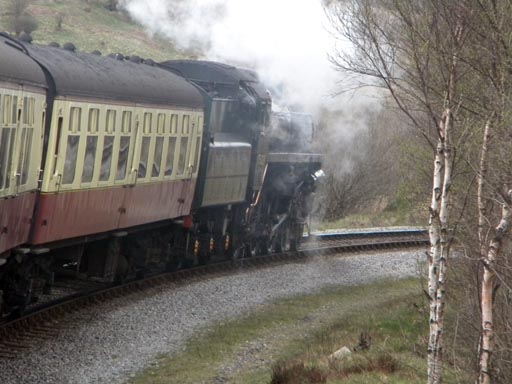
So said Major John Cartwright in his treatise Take Your Choice published in 1776, a document in which he enunciated the very same six points later to be packaged by the Chartists in 1838 as the People's Charter, some 62 years later. When then is the link between these and the picture of a steam train? Well, the picture was taken yesterday when we were guests of the North Yorkshire Moors Railway who very generously made available their facilities so that I could be filmed talking about the Chartists against such an impressive backdrop – all part of our Harrogate Agenda foundation video. The idea was our producer's, who found that the railway had been established within a couple of years of the publication of the People's Charter, providing good visual cues for the interview, also raising the role of the railways in helping the Chartist message to be spread so widely. Fortified by equally generous hospitality from the delightful refreshment room at Pickering Station, done out in the early British Railway colours, we then moved on Leeds University and the School of History, where we interviewed Professor Malcolm Chase, one of the leading authorities on Chartism, and author of the definitive book on the subject. What followed was a masterclass on Chartism, in which we were also introduced to John Cartwright, all captured on film. The interview will add a powerful dimension to our video, which is slowly taking shape. However, back home, the sheer intensity of the work has left me exhausted, so I will have to do catch-up in the morning after a night's sleep. COMMENT THREAD Richard North 10/05/2013 |


 Posts
Posts

